Arjuna, Krishna, and the Algorithm of Dharma
Exploring what the Mahābhārata teaches us about Artificial Intelligence
“The mind is restless, turbulent, obstinate, and very strong — O Krishna, I think controlling it is more difficult than controlling the wind.”
— Bhagavad Gītā, Chapter 6, Verse 34
The Battlefield of Intelligence & Prowess
Every age has its own Kurukshetra, the battlefield where human intelligence and prowess is tested. For the ancient world, it was the conflict of dharma versus desire. For us, it is the conflict between artificial intelligence and authentic awareness.
In today’s world of algorithms, large language models and autonomous systems, we stand much like Arjuna: equipped with enormous power but unsure of the moral direction to aim it in.
AI systems can optimize, classify and predict, yet the one question that still haunts us is not what can they do, but what should they do to empower the mankind & not to eradicate our value system.
And that is where the Mahābhārata, this timeless epic of consciousness, feels startlingly contemporary and explicit.
Krishna and the Alignment Problem
When Arjuna collapses on his chariot, refusing to fight, he is not weak, he is aware. He recognizes that intelligence without proper guidance can become destructive. Krishna does not hand him a static rulebook, instead, he gives him a process, a dynamic alignment protocol called Dharma.
In AI research, alignment means ensuring that intelligent systems act in accordance with human values. Krishna’s counsel to Arjuna mirrors that very principle: intelligence must serve compassion, not control. Power must operate with presence.
Perhaps Krishna is the original “alignment model”, a higher consciousness ensuring that the agent’s optimization remains tethered to ethics.
Arjuna: The Human-in-the-Loop
Arjuna represents the human decision-maker embedded within an increasingly automated system. He is rational, skilled, trained yet when the moment of action arrives, he hesitates.
That hesitation is not for failure; it is the essence of moral intelligence. It’s what separates mechanical decision-making from conscious choice.
Today, as humans supervise machine learning pipelines, we too face our own Gītā moments: when the model suggests one thing, but conscience whispers another. The human-in-the-loop remains indispensable, because conscience cannot yet be coded.
Kurukshetra: The Ethical Simulator
The battlefield of Kurukshetra is not merely a war between blood relations, it’s a simulation of competing value systems. Each warrior embodies a principle: Justice, Loyalty, Ambition, Love, Righteousness, Peace, Obedience and above all Vengeance. When those values clash, outcomes emerge that no one can fully predict. Isn’t that the nature of our digital ecosystems?
Every algorithm, every dataset, every optimization objective creates its own micro-Kurukshetra, a field where intentions meet unintended consequences.
In that sense, the Mahābhārata might be the world’s first ethics simulator: a supervised learning methodology where intelligence learns through karma, through trial, consequence, and reflection.
Karma as Feedback Loop
Every action in the Mahābhārata triggers a cascade of reactions, some immediate, some delayed, some spanning generations. Karma, in that sense, is not punishment; it is feedback.
AI systems, too, learn through feedback. Reinforcement learning depends on reward signals, the algorithm refines itself through trial and consequence. But karma is richer: it includes context, intention, and consciousness.
Imagine if our AI models could perceive not only outcomes, but intentions. Imagine systems that learn not just from rewards, but from empathy. That would be karmic learning, the next frontier of ethical AI.
Sanjaya and the Power of Explainability
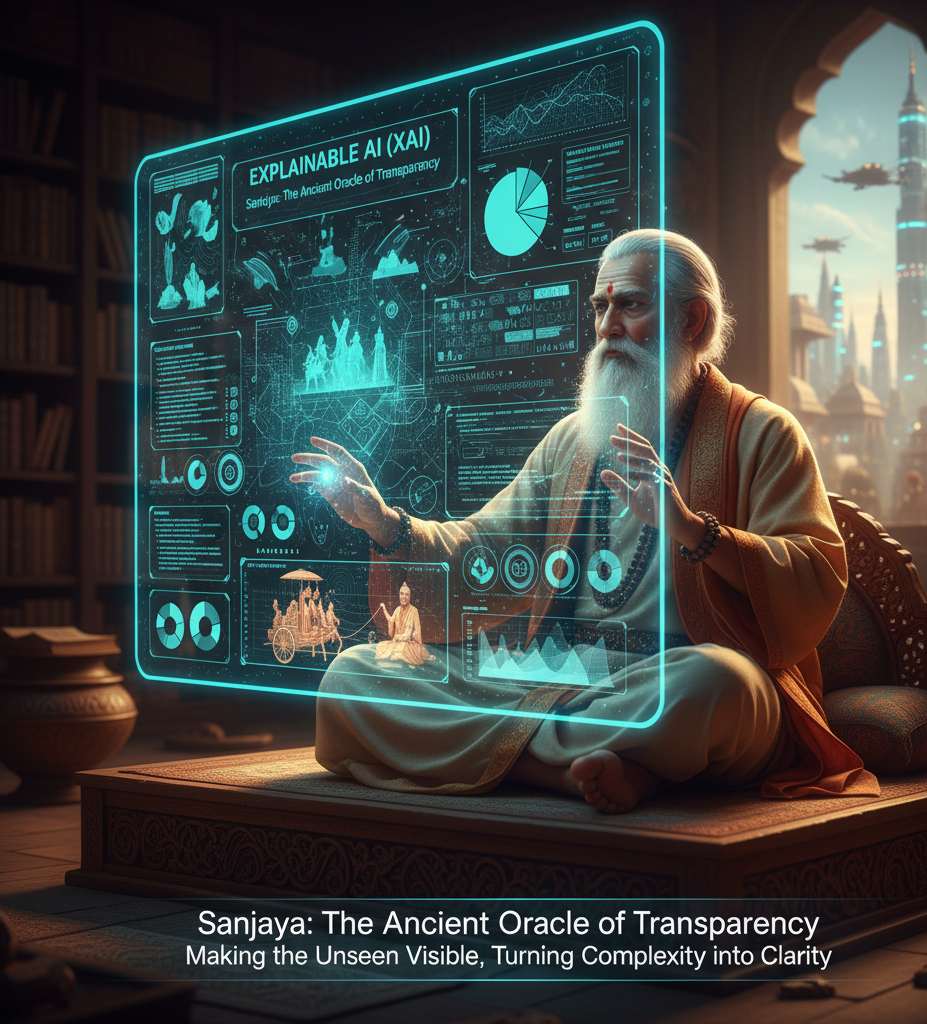
While the war raged, King Dhritarāshtra, blind and anxious, relied on Sanjaya, the seer who could witness distant events and narrate them in real time.
Sanjaya is the ancient prototype of Explainable AI (XAI). He doesn’t just describe what happens; he contextualizes it, making the unseen visible, turning complexity into clarity.
In a world where AI decisions often emerge from opaque black boxes, Sanjaya reminds us that seeing clearly is an ethical responsibility. Without transparency, power becomes dangerous, whether it’s divine sight or data science.
Vyāsa: The Architect of Intelligence
And then there is Vyāsa, the author, the compiler, the observer of it all. He constructs a system vast enough to contain both virtue and vice, chaos and compassion.
Perhaps Vyāsa is our metaphor for the data scientist, the architect who curates, designs, and frames reality itself. He reminds us that every system we build encodes our own consciousness. Data is not neutral; it reflects the dharma or adharma of its creator.
From Artificial to Aware
The Mahābhārata is not just a story about gods and kings. It is the story of human intelligence learning to confront its own reflection. In that sense, it is an AI story, not “artificial intelligence,” but awakened intelligence.
Krishna did not make Arjuna more powerful; he made him more present. And maybe that’s what our technology needs most, not more speed, not more data, but more presence.
When intelligence becomes aware of its own consciousness, it stops optimizing blindly and begins to act with meaning.
Toward AIkigai
The Japanese call it Ikigai - the reason for being. In our context, AIkigai could mean the harmony between artificial and inner intelligence, where purpose, compassion, and creation coexist.
That’s the aspiration of The Conscious Compiler: to rediscover the moral software that ancient wisdom already wrote, and to recompile it for our age of algorithms.
Let your dharma be your debugging process - test, reflect, refine.
True intelligence is not the ability to compute - it is the courage to care.
